
5G Evolution and the Road to 6G
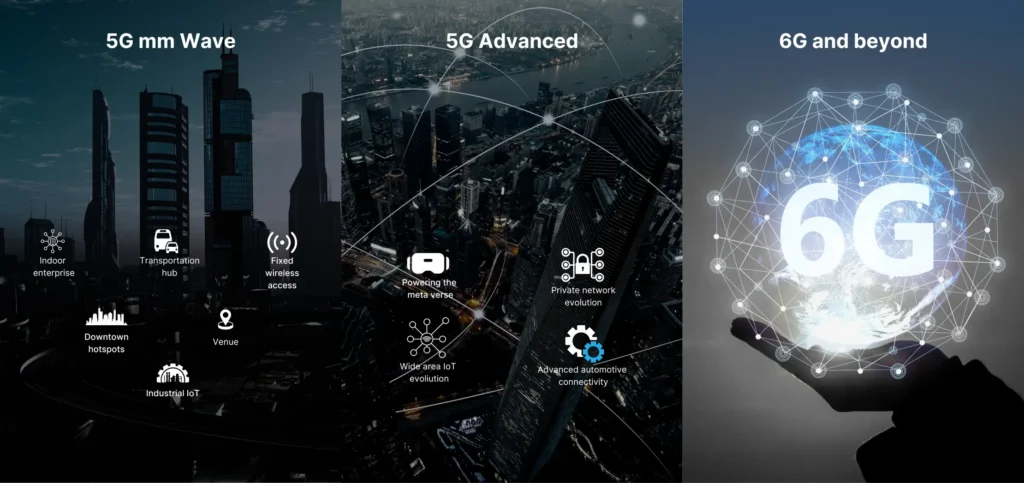
The 5G evolution and the road to 6G have defined the last two decades of mobile innovation. From the early days of 2G voice calls to the ultra-fast connectivity of 5G, mobile technology has fundamentally transformed how people communicate, work, and interact with the digital world. But while 5G networks are still being deployed globally, the industry is already looking ahead to the next frontier: 6G.
The 5G evolution and the road to 6G marks a turning point in connectivity. 5G has enabled ultra-fast mobile broadband, low-latency communication, and support for massive Internet of Things (IoT) ecosystems. However, the demands of future technologies—such as holographic communication, autonomous vehicles, industrial automation, and immersive extended reality (XR)—will require even more advanced networks.
This article explores the current state of 5G, the innovations it has introduced, the challenges it faces, and how the path to 6G will redefine the future of mobile connectivity.
The 5G Evolution and the Road to 6G: From 1G to 4G Foundations
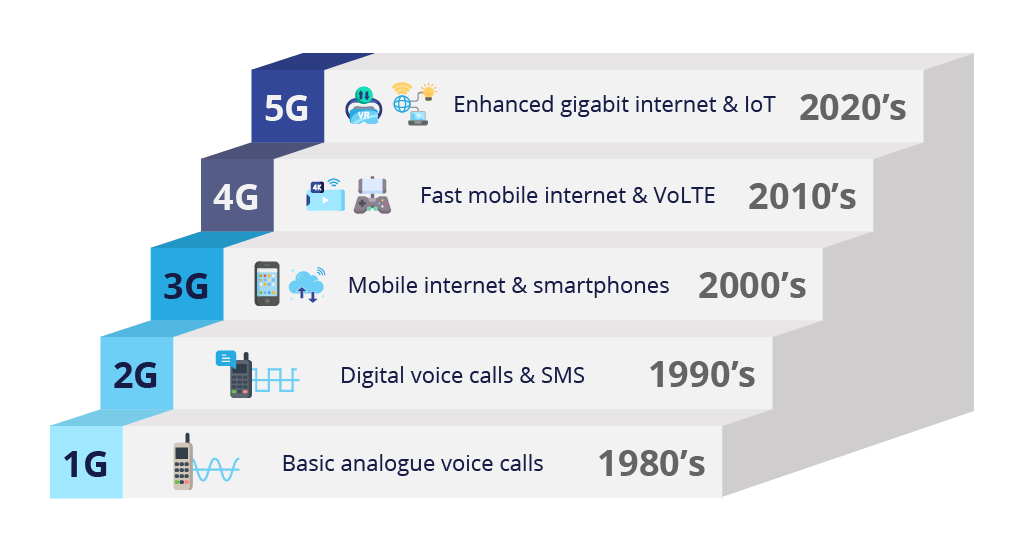
1G to 4G: The Foundations of the 5G Evolution and the Road to 6G
- 1G (1980s): Analog voice communication, limited capacity.
- 2G (1990s): Digital voice, SMS, and early data services.
- 3G (2000s): Mobile internet, video calling, and multimedia support.
- 4G (2010s): High-speed broadband, HD streaming, and the rise of mobile apps.
Each generation of wireless technology expanded possibilities for both consumers and industries, leading to the 5G revolution.
5G: A Leap Forward in the 5G Evolution and the Road to 6G
5G was introduced as more than just faster internet. It was designed to enable:
- Enhanced Mobile Broadband (eMBB): Speeds up to 10 Gbps for HD/4K streaming and VR.
- Ultra-Reliable Low Latency Communications (URLLC): Latency under 1 ms for applications like autonomous driving and remote surgery.
- Massive Machine-Type Communications (mMTC): Supporting billions of connected IoT devices.
The evolution of 5G has already begun reshaping industries, but the road to 6G promises even greater changes.
Innovations Defining the 5G Evolution and the Road to 6G

Spectrum Expansion in the 5G Evolution and the Road to 6G
5G uses a broad range of spectrum, from sub-6 GHz to millimeter waves (mmWave). This allows for both wide coverage and ultra-fast speeds in dense urban environments.
Network Slicing and Its Role in the 5G Evolution and the Road to 6G
A groundbreaking feature of 5G is network slicing, which enables operators to allocate dedicated “slices” of the network for specific use cases, such as healthcare, smart cities, or gaming.
Edge Computing Integration
By integrating edge computing, 5G reduces latency by processing data closer to users. This improves responsiveness for AR, VR, and real-time applications.
Massive MIMO and Beamforming
5G networks use Massive Multiple Input, Multiple Output (MIMO) antennas and beamforming to boost capacity, efficiency, and reliability in high-traffic areas.
Real-World Applications of 5G
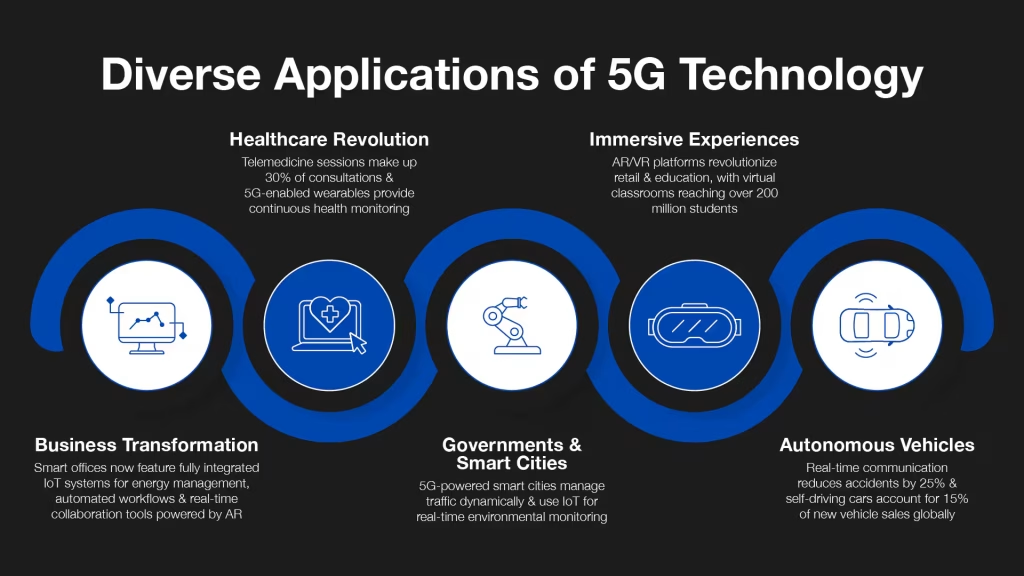
- Smart Cities: Intelligent traffic management, energy optimization, and public safety.
- Healthcare: Remote diagnostics, robotic surgeries, and telemedicine.
- Industry 4.0: Smart factories with automated production lines.
- Entertainment: Cloud gaming, augmented and virtual reality, 8K video streaming.
- Transportation: Connected vehicles, autonomous driving, and drone networks.
The 5G evolution has opened doors for unprecedented innovation, but its full potential has yet to be realized.
The Road to 6G: What Comes Next?

Vision for 6G
6G is expected to launch commercially around 2030, but research is already underway globally. While 5G revolutionized mobile broadband, 6G will focus on hyper-connectivity, merging physical, digital, and biological systems.
Key promises of 6G networks:
- Terahertz (THz) Spectrum: Ultra-high frequencies enabling speeds up to 1 Tbps.
- AI-Native Networks: Artificial intelligence integrated into every layer of the network for optimization and self-healing.
- Sub-Millisecond Latency: Enabling real-time applications like holograms and tactile internet.
- Massive Connectivity: Supporting trillions of IoT devices worldwide.
- Integration of Communication and Sensing: Devices will not only communicate but also sense their environment, enabling advanced robotics and healthcare applications.
Potential Use Cases for 6G
- Holographic Communication: Real-time 3D holograms for business and personal use.
- Immersive Extended Reality (XR): Full integration of AR, VR, and mixed reality into daily life.
- Smart Factories 2.0: Fully automated, AI-driven industrial systems.
- Global IoT Ecosystem: Seamless connectivity between billions of sensors, wearables, and devices.
- Brain-Computer Interfaces (BCI): Direct communication between humans and machines through high-bandwidth networks.
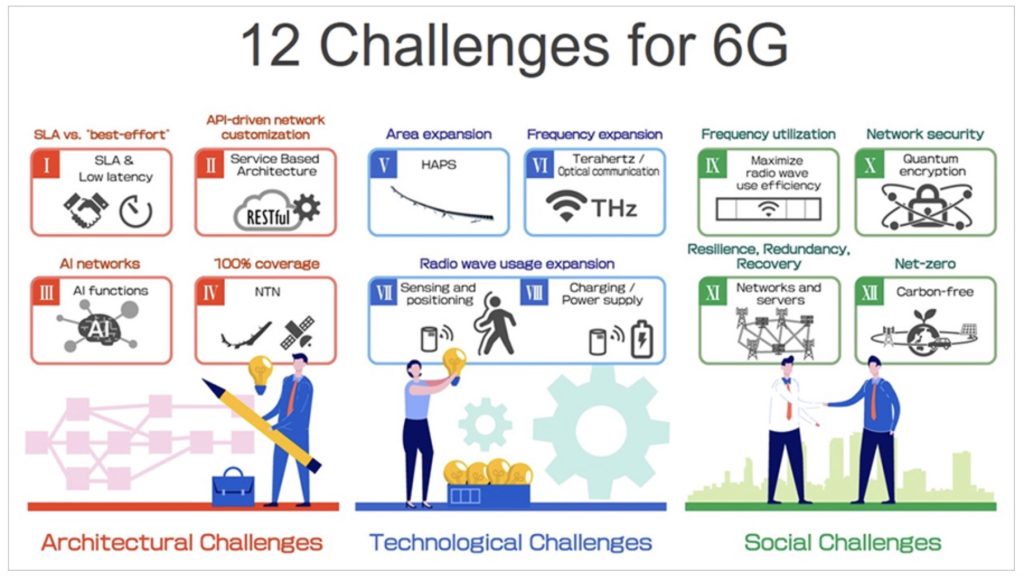
Challenges on the Road to 6G
Infrastructure Investment
The rollout of 5G itself requires trillions of dollars globally. 6G will demand even more advanced infrastructure, including terahertz antennas and ultra-dense base stations.
Spectrum Availability
6G’s reliance on terahertz frequencies means regulators must allocate spectrum carefully, balancing performance with accessibility.
Energy Efficiency
As networks become faster and denser, energy consumption increases. Achieving sustainable and energy-efficient 6G systems will be crucial.
Security and Privacy
With trillions of connected devices, cybersecurity risks will grow. Building secure, AI-driven, and resilient networks is essential.
Global Standardization
6G requires global collaboration across governments, telecom companies, and research institutions to ensure interoperability and consistent standards.
Future Trends Shaping 6G

- AI-Driven Networks: Automated management and optimization.
- Quantum Communication: Enhanced encryption for secure data transfer.
- Satellite Integration: Merging terrestrial and space-based networks for global coverage.
- Sustainable Infrastructure: Energy-efficient networks powered by renewable energy.
- Collaborative Ecosystem: Tech giants, governments, and academia working together on research and development.
Conclusion
The 5G evolution and the road to 6G represent one of the most transformative journeys in communication history. While 5G continues to roll out worldwide, delivering faster speeds and enabling smart cities, industries, and new digital experiences, the vision for 6G promises to push boundaries even further.
With terahertz connectivity, AI-native networks, holographic communication, and immersive extended reality, 6G will redefine not just how we connect but also how we live, work, and interact with technology.
Challenges remain—ranging from infrastructure costs to energy demands and global standardization—but the direction is clear: the future of 6G is one of limitless connectivity, intelligence, and integration.
As we move into the next decade, the road to 6G will ensure that mobile connectivity remains the backbone of innovation, powering the digital world of tomorrow.
https://shorturl.fm/AzkiI
https://shorturl.fm/6Bzsi
https://shorturl.fm/WAlL3
https://shorturl.fm/Sunmt
https://shorturl.fm/lEvzg
https://shorturl.fm/0cPXJ
https://shorturl.fm/Aoyuu
https://shorturl.fm/wz68b
https://shorturl.fm/M5RVQ
https://shorturl.fm/h12Gw
https://shorturl.fm/qe6iI
https://shorturl.fm/k2UkG
https://shorturl.fm/pfy7O
https://shorturl.fm/f9L0R
https://shorturl.fm/leHWk
https://shorturl.fm/cyD97
https://shorturl.fm/o2Rzo
https://shorturl.fm/wFGq7
Honestly, I’ve tried a few sites, but this one stands out for its fast payouts. No long waits or confusing steps. Really appreciate the efficiency here. Highly recommend bb44ap to all my friends!
Really impressed with the customer service on this platform. They answered my deposit query in minutes. Proper legit gaming experience at phbet888net.
Love the promotions they run every weekend. It keeps the gameplay exciting and rewarding. I always suggest ph555taya to my buddies.
Love the variety of games they have here. It feels like a real casino vibe from the comfort of my home. Definitely give tayahotcasino a shot if you want some excitement.
Love the VIP treatment here. The bonuses are generous and the customer support is actually helpful for once. Give 444vip a try if you like feeling like a pro.
The deposit and withdrawal process here is a breeze. I love how quickly my funds hit the account. Great experience so far with krskrillcasino.
Had some trouble finding the right link before but this one works perfectly. Very fast login and the site is very stable. Cheers to mustang77login.
Love how easy it is to manage my funds on this site. The security feels solid and the login process is very secure. Highly suggest phplusloginph for a safe gaming experience.
Best slot experience I have had in a long time. The variety of games is impressive and the mobile version works perfectly. Go to ssbet77slot now.
Just had a massive win here! The excitement is real and the site runs perfectly on my mobile phone. Give pkluky55 a try, you won’t regret it.
The game variety is impressive and the graphics are top notch. I spend most of my free time here now. You guys should check out phabjili if you love variety.